 Harbour Guard
The right access, for the right reason, at the right time.
Harbour Guard provides dynamic, policy-driven access control for sensitive data, services and operational applications, evaluating who is requesting access, what they are reaching, the context of the request and the applicable mission policy.
What it does
System behaviour
Harbour Guard provides dynamic, policy-driven access control for sensitive data, services and operational applications. It evaluates who is requesting access, what they are trying to reach, the context of the request and the applicable mission or organisational policy. It has its own sign-in and administration, and is linked to Consilium, where its policies are enforced live inside the C2 platform. It can also operate independently or integrate with ByteHarbour and third-party systems.
Position in the ecosystem: Deploy Harbour Guard as a standalone access-control capability, or as the policy decision layer across the wider Espanaro solution set.
Three principles
The principles behind Harbour Guard
Dynamic
Adapt access decisions as identity, mission and operating context change.
Precise
Apply granular controls to data, services, functions and individual actions.
Auditable
Record the policy, attributes and context behind each access decision.
The challenge
Defence, national security and critical-infrastructure organisations need to protect sensitive information without preventing authorised people from acting at pace.
Traditional role-based access controls are often too static for operational environments, where permissions must respond to changing identity, location, device posture, mission, classification and threat context.
Operational value
Harbour Guard delivers:
- Context-aware decisions
- Least-privilege access
- Reduced standing permissions
- Consistent policy enforcement
- Improved auditability
Harbour Guard provides a dynamic policy decision and enforcement layer that evaluates each access request against identity, attributes, environmental context and mission rules, letting organisations move beyond broad, permanent permissions to decisions that reflect data sensitivity, current need and the operating situation.
Architecture
How it works
Harbour Guard works in four steps, from evaluate to audit.
- 01EvaluateIdentity, attributes and context
- 02DecideAgainst mission policy
- 03EnforceThrough connected systems
- 04AuditRecord every decision
Core capabilities
Four building blocks for dynamic, policy-driven access
Policy Decision Engine
Evaluate each access request against identity, resource, context and mission policy.
Attribute-Based Access Control
Use user, device, data and environmental attributes to make granular decisions.
Policy Administration
Define, test, version and manage access policies through controlled workflows.
Enforcement & Audit Services
Apply decisions through connected systems and retain an auditable record of outcomes.
Solution in action
See Harbour Guard working
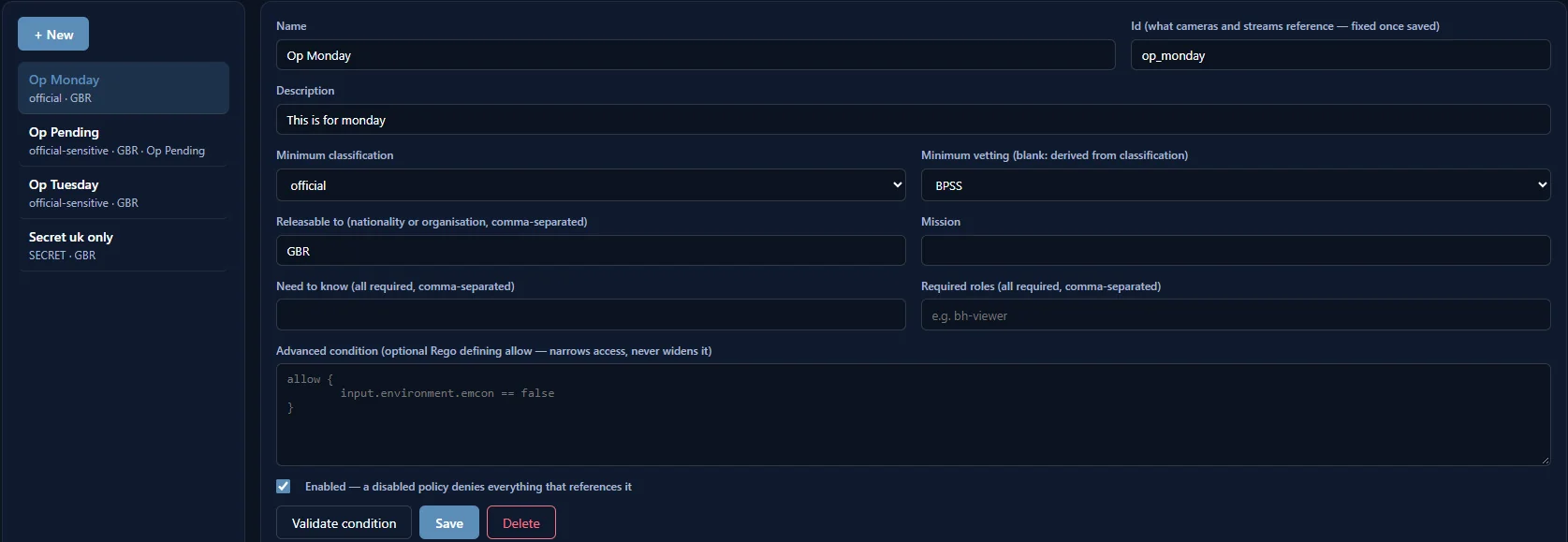
Harbour Guard holds the access policies, classification scheme and principals that decide who may see what. It has its own login and administration, and is linked to Consilium, where its policies are enforced inside the C2 platform. These screens come from an Espanaro demonstration environment.
Policies, users and classifications shown are examples. Each deployment is configured to the customer identity model and mission rules.
Use cases
Where Harbour Guard makes the difference
Mission-Based Access
Grant time-bound access according to operational task, location and mission need.
Sensitive Data Protection
Control access to classified, commercially sensitive or personally identifiable information.
Cross-Organisation Collaboration
Enable partners to access approved resources without inheriting broad internal permissions.
Application Modernisation
Add modern policy controls around legacy or specialist systems without replacing them.
Zero-Trust Architecture
Evaluate every request using current identity, device and environmental context.
Trials & Evaluation
Test policy models, attributes and enforcement patterns in controlled pilot environments.
Integration and deployment
Works with the systems you already run
Harbour Guard evaluates each access request against identity, attributes, environmental context and mission rules, letting organisations move beyond broad, permanent permissions to decisions that reflect data sensitivity, current need and the operating situation.
| Integration area | Supported approach |
|---|---|
| Identity & directory services | Connect to existing identity providers, directories, roles, claims and authentication services. |
| Applications & APIs | Integrate policy decisions with web applications, services, APIs and operational workflows. |
| Data & information platforms | Apply controls to data access, sharing, querying, transformation and presentation. |
| Security & context sources | Consume device posture, network, location, classification, mission and threat attributes. |
| Espanaro solutions | Integrate with ByteHarbour for governed exchange and Consilium for operational access control. |
Delivered with Espanaro
Context-aware access control, built in the UK
Supported by Espanaro capability
The engineering teams behind Harbour Guard also support its integration, deployment and operation.
How to engage
- 1Discovery
Understand the access-control problem, environment and existing identity and data systems.
- 2Policy Workshop
Shape attributes, policies and enforcement options around your mission and constraints.
- 3Pilot
Evaluate Harbour Guard in a controlled deployment ahead of wider operational rollout.
Solution datasheet
Download the Harbour Guard Datasheet
A concise technical overview of Harbour Guard: capabilities, use cases, integration and deployment. Fill in your details and the datasheet unlocks immediately.
- Technical capability summary
- Operational use cases and deployment context
- Integration and ecosystem overview
- PDF, free to download
Discuss Harbour Guard
Give the right people access, for the right reason and at the right time.
Speak to Espanaro about a Harbour Guard policy workshop, access-control discovery or pilot deployment.